How did Newport Beach start as a place of commerce?
The City of Newport Beach General Plan dates the first commerce at the bay to 1870, when a stern wheeler traded lumber for hides, tallow, livestock and grain. James McFadden and ranch owner James Irvine named the landing on the bay "Newport."[1]
In 1888, because of the treacherous harbor entrance, McFadden moved the isolated settlement to the peninsula and built a wharf reaching deep water for large steamers. In 1891 the McFadden brothers completed a railway connection to Santa Ana, and the wharf area became a commercial and shipping center.[1]
That role did not last. In 1899 the federal government funded a new harbor at San Pedro, served by the Southern Pacific Railroad. The General Plan says the McFadden Wharf and railroad were sold to a beet-sugar producer in Los Alamitos, who six months later sold them to the Southern Pacific Railroad, signaling the end of Newport as a commercial shipping center.[1] The General Plan also lists the site of the original wharf built in 1888 by the McFadden brothers among its historic resources.[1]
Why it matters: if you are weighing waterfront property, ask what the site was built for. The commercial identity of the bay changed more than once.
What changed when Newport Beach became a resort?
In 1902 McFadden sold his Newport town site and about half of the Peninsula to William S. Collins, who took Henry E. Huntington as a partner in the Newport Beach Company.[1] The Pacific Electric Railroad established itself in Newport Beach in 1905, connecting the City of Los Angeles by rail, and Red Cars brought visitors, followed by hotels and cottages.[1]
Between 1902 and 1907, many of the city's waterfront communities were subdivided, among them West Newport, East Newport, Balboa, Corona del Mar and Balboa Island.[1] The Balboa Pavilion dates from the same moment: the General Plan says it was constructed in 1905 and has hosted numerous social and cultural activities.[1]
Why it matters: the resort turn left a legacy of waterfront subdivisions. If you are comparing a storefront or restaurant space near the water, check how the parcel was laid out and what the lot allows today.
When was Newport Beach incorporated and annexed?
On September 1, 1906, Newport Beach became the fifth city to incorporate in Orange County.[1] The County of Orange itself had been officially formed on August 1, 1889, with Santa Ana selected as the county seat.[8]
The city grew by annexation. The General Plan records that Newport Heights and Corona del Mar were annexed in 1917.[1] The City of Newport Beach also states that the current City Charter was adopted in 1954 and that the city operates under a Council-Manager form of government.[9]
Why it matters: confirm which neighborhood and zoning rules apply to a parcel before you compare it with one across town. If you are choosing between Corona del Mar and another part of the city, ask the city planning staff which rules apply to the specific address.
How did harbor dredging shape the Newport Beach waterfront?
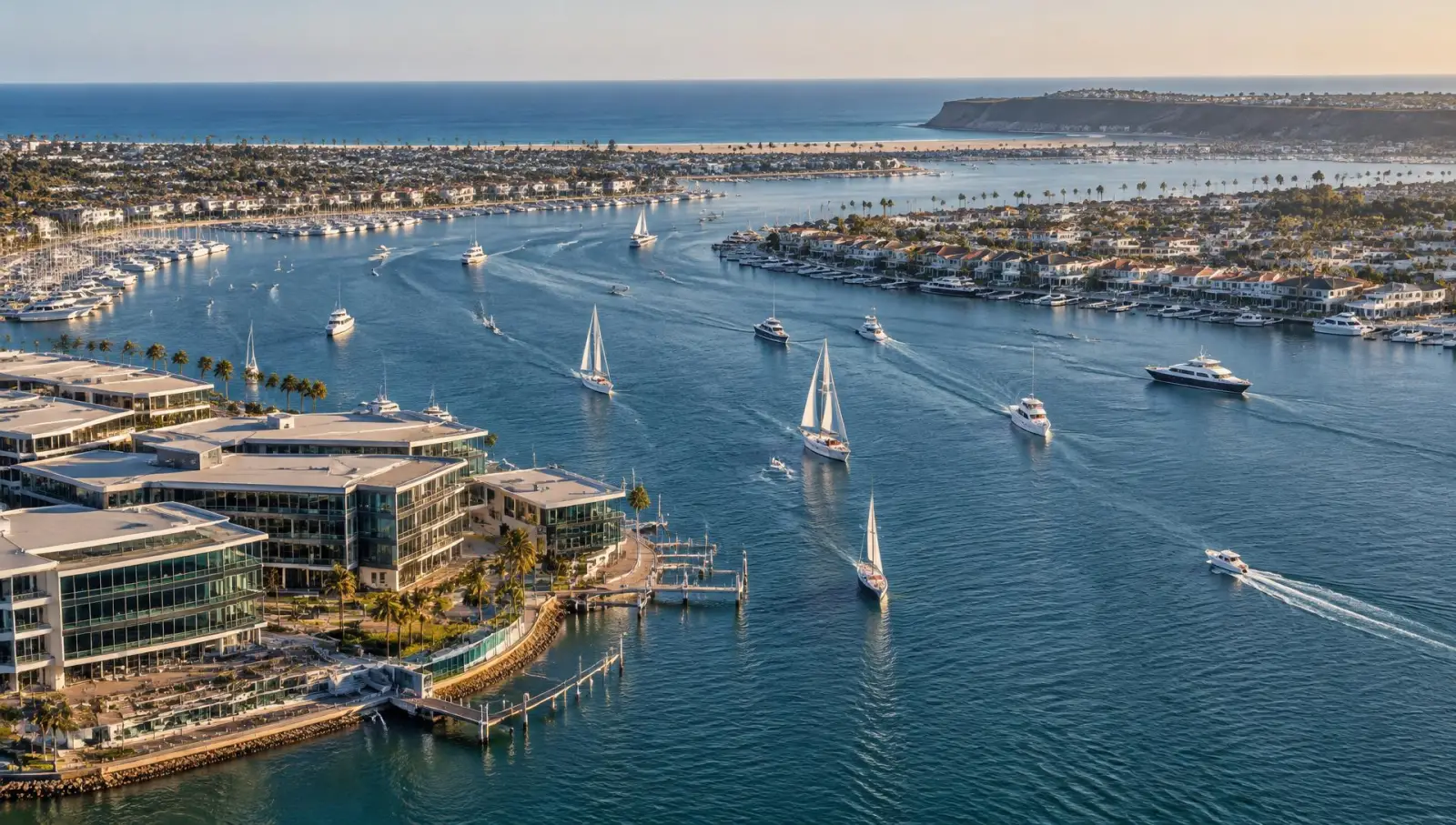
The General Plan says harbor entrance and channel work began in the 1920s. Between 1934 and 1936, the federal government and the County Harbor District dredged the Lower Bay, extended jetties and created the present day contour of Newport Harbor.[1]
Why it matters: the harbor you see today was reshaped by public works. If you are looking at a marine-related or waterfront commercial property, ask for the current dock, slip and shoreline permissions in writing rather than relying on what the previous owner used it for.
What did World War II and the freeway change?
During World War II the harbor became a vital hub as naval ships were built and repaired in its coastal waters. Servicemen from the Santa Ana Army Air Base visited Balboa, and many returned after the war to build homes.[1]
The General Plan says the Santa Ana freeway, built in the 1950s, triggered further growth, and that the fishing industry, once the backbone of Newport Beach's economy, gradually declined and was replaced by new businesses and commercial centers.[1]
Why it matters: older waterfront buildings may date from earlier uses, so ask about past uses before you buy or lease one.
How did Fashion Island and John Wayne Airport build the office and retail base?
The General Plan says that beginning in 1967 and through the 1970s and 1980s, the building of shopping centers such as Fashion Island, along with hotels, offices and restaurants, created the city's employment and retail areas.[1] The Fashion Island historical timeline gives its grand opening as September 9, 1967.[2] It opened with 909,000 square feet and four department stores.[2]
The airport has its own timeline. The County of Orange describes a land swap between the Irvine Company and the County of Orange,[3] and the City of Newport Beach says the County acquired the airport in 1939.[4] The County later renamed Orange County Airport to John Wayne Airport, Orange County.[3] John Wayne Airport is owned by the County of Orange and its address is Santa Ana, not Newport Beach.
Why it matters: Newport Center, the airport area and the retail districts grew from different decisions made at different times. If you are comparing office locations, ask each landlord what drew tenants to that submarket and whether that reason still holds.
Which Newport Beach properties are on the National Register of Historic Places?
The General Plan says four properties within the City have been listed on the National Register of Historic Places.[1] They are:
- Balboa Pavilion: the California Office of Historic Preservation records it as listed on 5/17/1984.[5] The National Park Service reference number is NRIS 84000914.[7]
- Crystal Cove Historic District: the California Office of Historic Preservation records it as listed on 6/15/1979 at 8471 North Coast Highway.[6] The City General Plan includes it among properties within the City; the State listing gives a Laguna Beach address, so treat the location as the City's statement.[1]
- Lovell Beach House: the General Plan says it was built in 1926 and designed by Rudolf Schindler.[1]
- Balboa Inn: the General Plan includes it among the four listed properties.[1]
What does Newport Beach history mean for a commercial decision today?
History does not set a rent or a price, and this page makes no claim about either. It helps with questions a buyer, seller or tenant should ask before committing.
If you are buying or leasing near a listed or older building, ask the city which review applies before you plan alterations. If you are comparing the harbor with the Newport Center area, ask what each location was built to serve. If you are selling a building with a history, gather its records before you list.
None of this replaces a title report, zoning check or legal advice. It is a starting list of questions for the people who will review your specific property.
If a Newport Beach property's history affects your decision, write down the address and what you plan to do with it, and ask the city which rules apply before you commit.
Prepare a note about what you are weighingQuestions people ask
When did Newport Beach become a city?
According to the City of Newport Beach General Plan, Newport Beach became the fifth city to incorporate in Orange County on September 1, 1906. Newport Heights and Corona del Mar were annexed in 1917. Ask city planning staff which jurisdiction and rules apply to an address near an old boundary.
What was the Pacific Electric Railroad's role in Newport Beach?
The City of Newport Beach General Plan says the Pacific Electric Railroad established itself in Newport Beach in 1905, connecting Los Angeles by rail. Red Cars brought visitors, and hotels and cottages followed. If you are evaluating visitor-serving property, ask how today's access and parking compare with that original rail-era pattern.
How did Newport Harbor get its present shape?
The City of Newport Beach General Plan says the federal government and the County Harbor District worked on the harbor between 1934 and 1936, dredging the Lower Bay and extending jetties. That work created the present day contour of Newport Harbor. Ask for current dock and shoreline permissions before buying waterfront property.
When did Fashion Island open?
The Fashion Island historical timeline, published by the property, gives its grand opening as September 9, 1967, with 909,000 square feet and four department stores. The City General Plan describes Fashion Island as one of the shopping centers that, with hotels, offices and restaurants, created the city's employment and retail areas.
Is John Wayne Airport in Newport Beach?
No. The County of Orange owns John Wayne Airport and its address is Santa Ana. The County describes a land swap between the Irvine Company and the County of Orange, and the City of Newport Beach says the County acquired it in 1939. If airport access matters to your search, ask each landlord for travel times.
Which Newport Beach properties are on the National Register of Historic Places?
The City of Newport Beach General Plan says four properties within the City are listed: Balboa Inn, Balboa Pavilion, Crystal Cove Historic District and Lovell Beach House. The California Office of Historic Preservation records Balboa Pavilion as listed on 5/17/1984. Ask the city what review applies before altering any older building.